How to Win at Chicken Road: Expert Strategies, Tips and Smart Play

What Is Chicken Road?
Chicken Road is a crash-style casino game from InOut Games where a chicken jumps over ovens on a road while a multiplier climbs with each step it survives. Every oven cleared raises the payout. Every oven is also a chance to lose your stake. That tension is the entire game.
How a Round Works
- Place your bet before the round begins
- The chicken moves toward the first oven
- The multiplier rises with each oven cleared
- At every step, you decide: cash out now or let the chicken continue
- If the chicken gets hit before you cash out, your stake is lost
Game Parameters
Standard play runs from a €0.01 minimum stake to a €200 maximum, with a €20,000 session win cap. If you stake €200 and target 100x multipliers, you’ll hit the cap before the multiplier does. Plan your stake-to-multiplier ratio accordingly. There’s no traditional auto-play button, which makes the auto-cashout feature the most important tool available.
Difficulty Levels
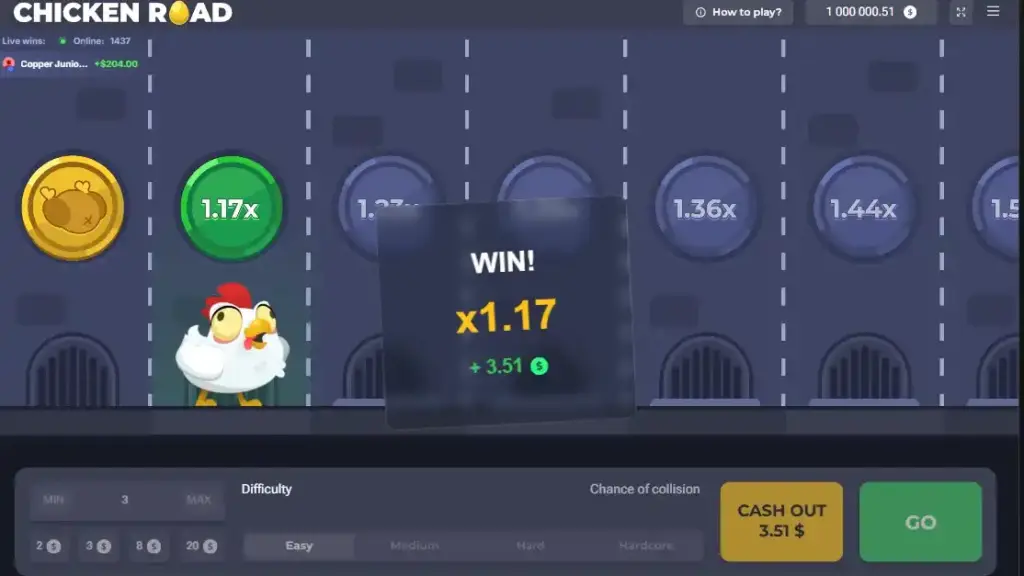
| Difficulty | Risk Per Step | Recommended For |
|---|---|---|
| Easy | Lowest (~96% survival per step) | Beginners, conservative play |
| Average | Moderate | Regular sessions |
| Hard | High | Experienced players, larger bankroll |
| Hardcore | Very High | High-risk specialists only |
Easy mode carries approximately 96% per-step survival probability and a 98% RTP. Volatility rises sharply with each tier, meaning the same RTP plays out with far wilder swings on Hardcore.
RNG and Provably Fair
Each round’s outcome is generated by a cryptographically secure RNG before the animation starts. No pattern exists to exploit. The provably fair system lets you verify results using SHA-256: the casino publishes a hash of the server seed before play and reveals the original seed after each round. Past busts tell you nothing about the next one.
Can You Actually Win at Chicken Road?
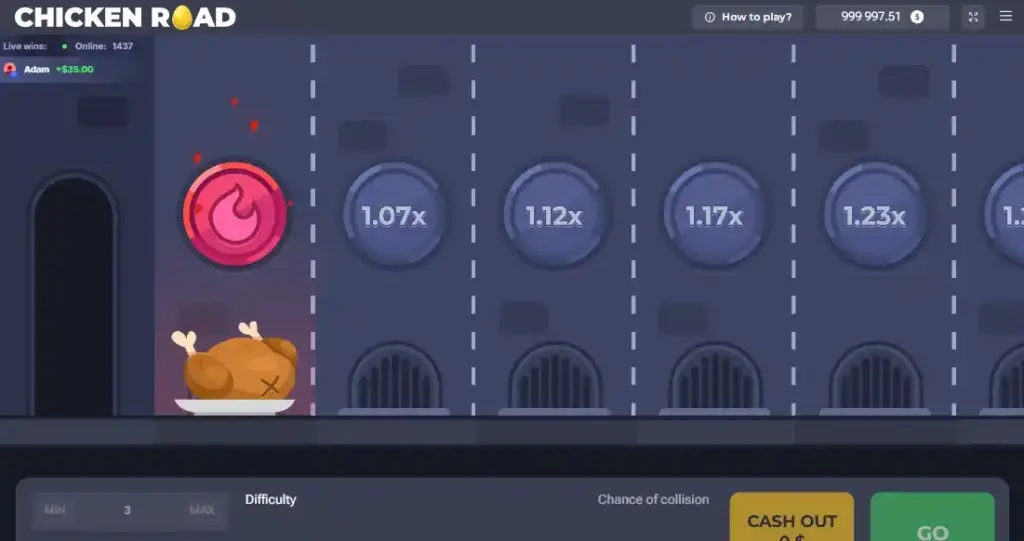
Yes, but “winning” needs a clear definition. Profitable sessions happen. Beating the house edge across thousands of rounds doesn’t. Chicken Road carries roughly a 2% house edge at 98% RTP, which compares well against typical slots sitting between 94% and 96%. Short-term variance creates real winning opportunities. Strategy determines whether you capture them or give them back.
The Math Behind Each Step
Each oven is an independent event. Cumulative risk compounds. Using Easy mode’s approximate 96% per-step survival rate:
- 1 step: 96% survival
- 3 steps: 88.5%
- 5 steps: 81.5%
- 10 steps: 66.5%
Even on the safest difficulty, surviving 10 consecutive steps happens only two-thirds of the time. That’s not a flaw. It’s the game. Understanding this separates players who manage Chicken Road intelligently from those treating each oven as a coin flip.
My Top Strategies for Chicken Road

No strategy overcomes RNG. What these approaches do is give you a structured way to engage with probability, with specific numbers, specific decisions, and specific exit points.
Conservative Cash-Out Strategy (Low Risk)
Cash out at 1.2x to 2x on Easy difficulty, consistently, across many rounds. Cashing out after two steps generates roughly an 11% return per round at approximately 88.5% cumulative survival probability. Stake 1 to 2% of session bankroll per round. On a £100 budget, that’s £1 to £2 per round and 50 to 100 rounds minimum. The discipline is the strategy. I use this whenever I’m testing a new platform or returning after a break.
Aggressive Multiplier Approach (High Risk)
This targets 5x to 10x on Hard, or minimum stakes targeting 100x on Hardcore. You need a buffer to absorb 10 or more consecutive busts, because on Hardcore that’s not unusual. At 1% of bankroll per round, keep at least 150 units in reserve before starting. This approach suits players with a large session bankroll and the discipline to watch a 15-round losing streak without increasing stakes. I use it rarely, and only after banking profit from a conservative session first.
The Hybrid Strategy (Medium Risk)
My go-to for most sessions: 80% of the session budget at 1.5x to 2x targets on Easy or Average, with 20% reserved for 5x attempts on Hard. On a £100 budget, that’s £80 on Easy at £1 to £2 per round, and £20 on Hard at £1 per round targeting 5x. If I build profit, I shift a portion of those gains (not original bankroll) into Hard. If losses accumulate on Hard, I shift back down immediately.
Auto-Cashout: The Most Important Tool in the Game
The worst decision I’ve made in Chicken Road happened in about two seconds. I was at my pre-set target, the multiplier was still climbing, and I held. The chicken didn’t make it. Auto-cashout removes that window entirely. Set it before the round starts and the game cashes out at your target regardless of what you’re feeling.
| Strategy Tier | Auto-Cashout Target |
|---|---|
| Conservative | 1.3x to 1.5x |
| Hybrid | 2x to 3x |
| Aggressive | 5x to 10x |
Bankroll Management for Chicken Road
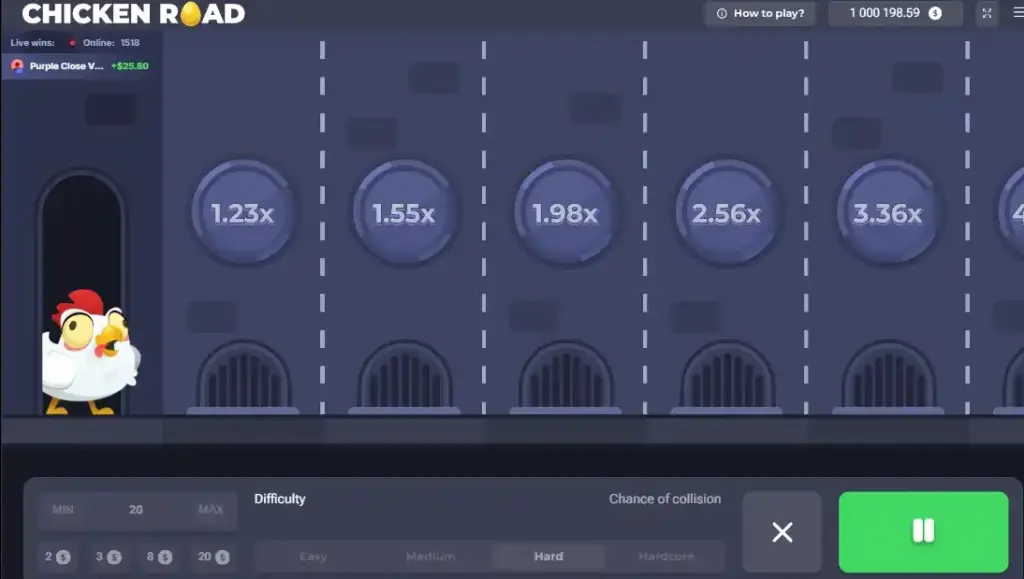
Strategy without bankroll management is a structure with no foundation. These are the rules I follow before every session.
Setting a Session Budget
Treat the session budget as already spent the moment you allocate it. It’s the cost of the entertainment. If you get it back, that’s the win. Set a deposit limit at the casino platform itself before logging in. This removes the option to top up mid-session when discipline is lowest.
Stake Sizing Per Round
The rule: 1 to 2% of session bankroll per round. On a £50 budget, that’s £0.50 to £1.00 per round and 50 to 100 rounds minimum. Flat-maximum staking looks confident and produces ruin faster than any strategy error. Avoid it.
Win and Loss Limits
- Stop-loss: 40 to 50% of session bankroll. When you’ve lost that amount, the session ends.
- Take-profit: double the session budget. When you hit it, stop.
- Mid-session withdrawal: when you’re up 50% of session profit, withdraw that amount immediately and continue with house money.
Both limits must be set before the session begins. Setting them mid-session, when you’re either on a winning streak or trying to recover losses, produces worse outcomes every time.
Mistakes I Made at Chicken Road
Chasing Losses
Four consecutive busts on Hard. Each felt like a statistical anomaly. By the fifth round, I’d doubled my stake to recover faster. That’s the gambler’s fallacy: the belief that past results influence the next round. They don’t. The RNG has no memory. Pre-set a stop-loss before the session starts and take a mandatory 10-minute break after three consecutive losses.
The Martingale Trap
Doubling your stake after every loss seems logical. The mathematics don’t support it. A losing streak of 8 to 12 rounds isn’t unusual on Hard or Hardcore. Starting at £1, seven consecutive losses require a £128 stake on round eight just to break even. Most bankrolls don’t survive long enough for the system to recover, and the RNG has no obligation to end a losing run at any particular point. Stop using it.
Holding Past Your Target
I was at 3.8x. My pre-set target was 3x. The multiplier was still climbing. I held. The chicken didn’t reach the next oven. When you’re already in profit, the bust probability per step doesn’t decrease. Auto-cashout solves this structurally. Set it before the round starts and the decision is already made.
Playing on Tilt
Tilt shifts decision-making from strategic to emotional. I know I’m on tilt when I’m staking more than my pre-set limit, changing difficulty after losses, or playing faster to “make up time.” The only correct response when you notice any of these: stop the session immediately. Not after one more round. Now.
Starting Without a Plan
Making stake size, difficulty, multiplier target, and cash-out decisions in real time under the pressure of a live round produces worse outcomes than even a basic pre-set approach. Write down the session strategy before logging in: difficulty level, stake size, cash-out target, stop-loss, take-profit. All of it, before the first round.
Choosing the Right Casino for Chicken Road

For UK players, UKGC licensing isn’t a recommendation, it’s a requirement. Verify the licence number on the Gambling Commission’s public register and confirm it shows as Active. Beyond licensing, look for published RTP around 97 to 98%, provably fair SHA-256 verification, withdrawals processed within 24 hours, and demo mode availability so you can test Chicken Road without real money. Responsible gambling tools including deposit limits, session time limits, and GAMSTOP integration should all be present and accessible before you deposit.
Bonuses: When They Help and When They Don’t
Bonuses can extend your session bankroll, but only under the right conditions. Wagering requirements of 35x mean a £50 bonus requires £1,750 in wagers before withdrawal. At 50x, it becomes £2,500 and the house edge will likely erode the bonus entirely. Some casinos explicitly exclude crash and arcade games from wagering contributions, so if Chicken Road falls into an excluded category, the bonus is worthless for this game. Check the eligible games and game contribution sections before claiming anything. My rule: only claim bonuses with wagering requirements of 35x or below, with confirmed 100% game contribution for Chicken Road.
Responsible Gambling
Chicken Road is a casino game with real money at stake. The shift from entertainment to problem gambling is gradual and then sudden. If any of the following feel familiar, free and confidential support is available right now.
Warning signs include gambling beyond your means, chasing losses by increasing stakes, needing to bet more to feel the same effect, repeated failed attempts to cut back, and hiding gambling activity from people close to you. Gambling affecting your work, relationships, sleep, or finances is a serious sign that support would help.
- GamStop: free self-exclusion covering all UKGC-licensed operators. Register at gamstop.co.uk in minutes.
- GamCare / BeGambleAware: free 24/7 helpline at 0808 8020 133. Information and support at begambleaware.org.
- NHS: your GP can refer you to the Primary Care Gambling Service.
Set deposit limits at every casino as a routine step when creating an account, not as a crisis response after a bad session. That’s when they’re most effective.
Frequently Asked Questions
Is Chicken Road rigged?
No. Chicken Road uses a cryptographically secure RNG. The provably fair system lets you verify each round independently using SHA-256: the casino publishes a hash of the server seed before play, then reveals the original seed after. If they match, the result wasn’t altered. You can check this yourself after any round.
What is the best strategy for beginners?
Start with the conservative approach on Easy difficulty: cash out at 1.5x to 2x, stake 1 to 2% of your session bankroll per round, and use auto-cashout. This gives you 50 to 100 rounds on a modest budget and enough variance to learn the game without rapid losses. Run at least 5 to 10 sessions this way before considering higher risk tiers.
What is the best multiplier to cash out at?
For most players, 1.5x to 2x on Easy offers the best balance of survival probability and return. At Easy’s approximate 96% per-step survival rate, cashing out at 2x after two steps gives roughly 88.5% cumulative survival. Higher targets are achievable but each additional step meaningfully reduces your odds.
Is there a pattern to when Chicken Road busts?
No. Each round is determined by a cryptographically secure RNG before the animation begins. Past bust points don’t influence future rounds. Sequences that look like patterns are the gambler’s fallacy at work. No betting system can predict or exploit RNG outcomes.
Which difficulty level should I play on?
Easy for most players, most of the time. It offers the lowest per-step bust probability at approximately 96% survival per step. Average suits players comfortable with moderate variance. Hard and Hardcore are only appropriate with a large bankroll buffer, strict stop-loss rules, and a specific high-multiplier strategy already in place.
Can I use Martingale on Chicken Road?
Strongly advised against it. Losing runs of 8 to 12 rounds are not unusual on Hard or Hardcore. Starting at £1, seven consecutive losses require a £128 stake on round eight just to break even. Most bankrolls don’t survive long enough for the system to work, and the RNG has no obligation to end a losing streak at any point.
How much should I start with?
Enough to cover 50 to 100 rounds at your intended stake. At £1 per round, a £50 to £100 session budget is a sensible starting point. Only use money you can afford to lose entirely. Never use funds allocated to bills, rent, or essential expenses.
Can I play Chicken Road for free?
Yes. Most UKGC-licensed platforms offer a demo mode allowing play without real money. Demo mode is the right place to test any new strategy before risking your bankroll. Run at least 50 demo rounds with any new approach before switching to real-money play.